National Sales Meetings (NSMs) have long been a staple of sales organizations—a chance to align teams, celebrate wins, launch new initiatives, and energize the field for the year ahead. Yet many companies still rely heavily on presentations, slide decks, and one-way communication. The problem? Information alone rarely changes behavior.
The most effective National Sales Meetings today are experiential. They move beyond passive learning and create opportunities for sales professionals to engage, practice, collaborate, and connect in meaningful ways.
Experience Drives Retention
Research consistently shows that people learn and retain information more effectively when they actively participate in the learning process. According to the National Training Laboratories’ Learning Pyramid, learners retain significantly more information through discussion, practice, and teaching others than through lectures alone.[1]
For sales organizations, this means that role-playing customer conversations, participating in simulations, and engaging in problem-solving exercises are often more impactful than sitting through hours of presentations.
When sales teams experience new messaging, products, or selling techniques firsthand, they are more likely to remember and apply them in the field.
Building Confidence Through Practice
Sales success depends on execution, not just knowledge. Experiential activities allow teams to rehearse critical skills in a low-risk environment before applying them with customers.
Interactive workshops, competitive team challenges, customer scenario simulations, and peer coaching sessions help sales professionals build confidence while receiving immediate feedback. This approach aligns with research on experiential learning, which emphasizes learning through concrete experience and reflection.[1]
The result is a sales force that leaves the meeting not only informed, but prepared.
Strengthening Human Connection
One of the greatest values of a National Sales Meeting is bringing people together. In increasingly distributed and hybrid work environments, face-to-face interactions are more important than ever.
Experiential events foster stronger relationships across teams, regions, and functions. Whether through collaborative challenges, shared volunteer experiences, or team-building activities, these moments create connections that extend beyond the meeting itself.
Research from Gallup suggests that strong workplace relationships contribute to higher employee engagement and performance.[3] Experiential programming creates the conditions for those relationships to form.
Turning Strategy into Action
Leadership teams often use NSMs to communicate strategic priorities. However, strategy can feel abstract when delivered solely through presentations.
Experiential sessions help bridge the gap between strategy and execution. Instead of simply explaining a new market approach or product launch, organizations can create simulations that allow teams to apply the strategy in realistic situations.
When participants actively engage with the concepts, they gain a clearer understanding of how strategic priorities translate into daily customer interactions.
Creating Memorable Moments
The most talked-about moments from successful National Sales Meetings are rarely the slides. They are the experiences.
People remember the customer panel that challenged their assumptions. They remember the collaborative problem-solving exercise that sparked a breakthrough idea. They remember the team challenge that built camaraderie and healthy competition.
Memorable experiences create emotional engagement, and emotional engagement is a powerful driver of motivation and behaviour change.[4]
The Future of National Sales Meetings
As organizations continue to invest in bringing their sales teams together, expectations are evolving. Attendees increasingly seek meaningful participation rather than passive observation.
The most effective National Sales Meetings are no longer measured by how much information was delivered. They are measured by what participants learned, how they felt, and what they do differently afterward.
Experiential design transforms meetings from corporate events into catalysts for performance. And when sales teams return to the field energized, aligned, and confident, the impact extends far beyond the meeting itself.
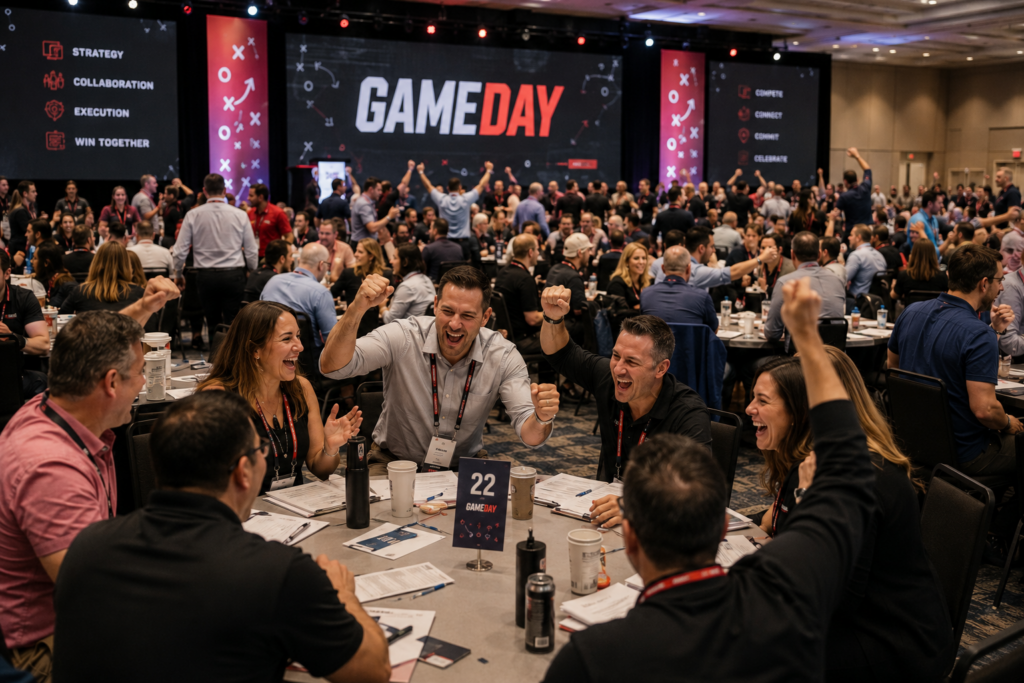
At Optimé International, we believe the best way to build sales readiness is through experience. GameDay™ is an immersive, customized business simulation that challenges sales teams in realistic customer scenarios, providing real-time feedback, skill development, and actionable insights. By combining competition, coaching, and assessment, GameDay™ helps teams identify performance gaps, strengthen capabilities, and prepare to achieve their goals.
Curious to see how GameDay™ could work for your organization? We’d love to chat—over a coffee, virtual or IRL! Click here: Connect with Optimé for a coffee!
Footnotes & References
- National Training Laboratories Institute for Applied Behavioral Science. Learning Retention Rates. NTL Institute. Available at: https://www.ntl.org
- Kolb, D. A. (1984). Experiential Learning: Experience as the Source of Learning and Development. Prentice Hall. 3.
- Gallup. State of the Global Workplace Report. Gallup, various editions. Available at: https://www.gallup.com/workplace
- Immordino-Yang, M. H., & Damasio, A. (2007). “We Feel, Therefore We Learn: The Relevance of Affective and Social Neuroscience to Education.” Mind, Brain, and Education, 1(1), 3–10.